
After discussing our second property budget planning and buying strategy, let’s talk about the financial side of renovation. This is our second home renovation, and compared to the first time, we now have more experience and a bigger budget. Since this is a home we plan to live in for the long term, we decided not to cut corners. This aligns with one of my financial philosophies: I am willing to pay for long-term value and quality of life and not be overly frugal on things I truly enjoy.
Renovation Budget and Trade-offs
Our renovation budget is around S$70K. Qanvast is a great platform for learning about renovation. After looking at many renovation case studies and cost breakdowns, I realized that our budget would not be enough to do a full-house makeover while ensuring both good design and high-quality finishes. With limited funds, I had to make trade-offs.
The focus was on:
- Kitchen layout restructuring and full renovation, as the kitchen and dining area are the heart of the home and the most frequently used spaces.
- Custom storage solutions with high-quality materials and good design.
- Aesthetic design elements, or what I call useless beauty, focusing on the entryway and living room as the visual focal points of the home.
I chose not to renovate:
- The bathrooms, since for a 10-year-old condo, they were still in good condition. The previous owner had not over-renovated, and the neutral design would not clash with the new renovation.
- The flooring, as the existing marble and solid teak floors could be polished and restored to fit the vintage aesthetic I wanted.
- The ceiling, since the previous owner had done simple false ceilings that concealed the wiring, making it unnecessary to redo.
By skipping these major renovation items, the S$70K budget felt sufficient without being too tight.
Comparing Different Types of Interior Designers
I shortlisted several interior design firms whose styles I liked, spoke with seven to eight designers, and received five quotations. From these, I noticed that IDs generally fall into two categories, with some firms somewhere in between.
The first type is traditional renovation contractors. Their process is straightforward: during the first meeting, they take notes on what the client wants, and at the second meeting, they provide a quotation based only on measurements and materials without discussing design details. After payment, they take the client to select materials such as tiles and countertops, then outsource the 3D renderings to a third-party designer. They do not provide electrical or cabinetry design drawings and expect clients to discuss requirements on-site with electricians and carpenters. During my first renovation, I followed this process: meeting with the carpenter on-site, where he sketched dimensions on paper.
The second type focuses more on design. After the first consultation, they present a preliminary design proposal in the second meeting, which includes suggestions for design style, color palettes, and sometimes basic 3D renderings. They also promise to provide detailed drawings for electrical work and cabinetry.
Each type has its pros and cons. The first type acts more like project managers, with strong contractor networks and flexible timelines, and they generally offer lower prices. However, they lack design expertise. My first renovation followed this approach due to budget constraints. In the current renovation, ID2 I talked to fell into this category, and their pricing was clearly more competitive.
The second type truly focuses on design, using AutoCAD, SketchUp, or other software. They have a strong design philosophy and maintain consistency between hard finishes and soft furnishings. Unlike project managers, they add real design value. Naturally, their fees are higher, and some charge separately for design services.

Quotation Analysis and Comparison
After receiving multiple ID quotations, I conducted a detailed comparison. Since each designer proposed different plans, I broke down their quotes and reorganized them into a comparison table. This made it easier to evaluate. Here’s a breakdown of key cost categories (link to download):
👩🏻💼 Professional Service
Some IDs do not provide 3D renderings or charge extra for them, while others do not offer detailed design plans and function only as project managers. Some waive design fees, such as ID1, but I noticed that their other items were priced higher to compensate. I personally prefer paying separately for good design while keeping construction costs transparent. ID5 was the most expensive in this category because they assigned two team members: one for design and another for project execution.

🔨 Hacking
Some IDs quoted a lump sum, while others itemized each demolition task. The price difference was not significant, but breaking down the costs helped identify missing items and avoid surprise charges later.

🧱 Masonry Work
This costs varied depending on tile area and material costs. I checked each ID’s price per square foot because choosing tiles more expensive than the quoted price would require a top-up. Cement screeding for walls was significantly more expensive. Three IDs suggested removing the entire kitchen wall tiles and screeding, while two suggested partial removal, keeping some existing walls and structures.

🪜 Ceiling and Partition Work
I kept my existing ceiling, so my quote was simpler. ID4 included a curved wall design, which I loved. This was a major reason why I chose them.

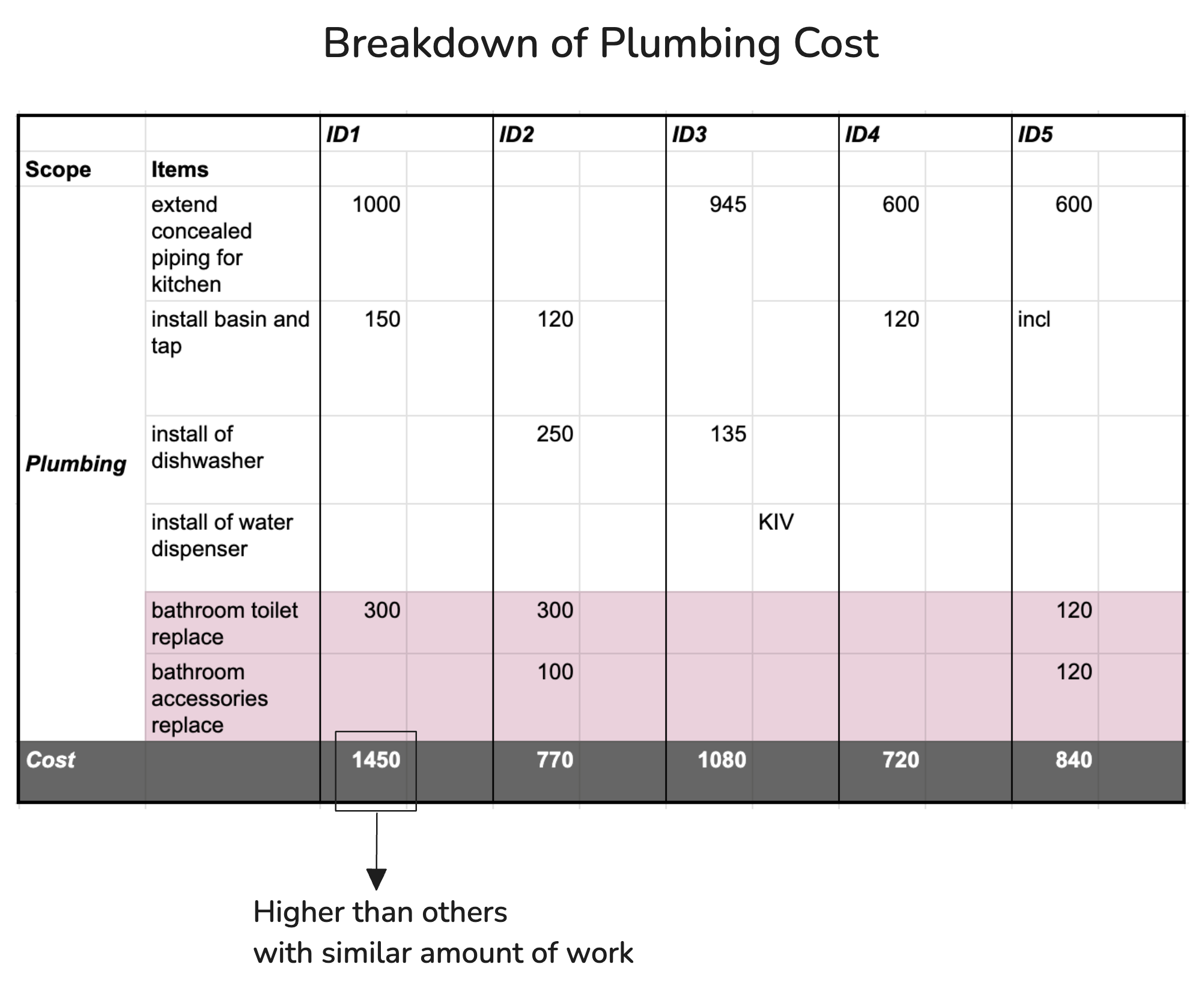
🧑🏻🔧 Plumbing
The main work involved repositioning the kitchen pipes. ID1’s quote was significantly higher, and I later noticed that several of their smaller categories were also more expensive.
🚪 Doors and Glass work
Price differences mainly resulted from different designs. I chose not to replace the yard door since it was in good condition and not a visual focal point. ID4 designed a beautiful green sliding glass door for the kitchen, which I was very satisfied with. For safety, I ensured that all glass used was tempered glass.

🪚 Carpentry
This was the largest cost component, I calculated cost per footrun to compare prices fairly. I also checked details such as the brand of hardware, extra charges for shaker-style doors, and restrictions on the number of drawers. ID4 had the highest price per foot, but there were no unnecessary restrictions. Most IDs limited three drawers per cabinet, but ID4 had no such limit. They also included BLUM hardware by default.

🧹 Painting, Floor and Misc
The quotes were fairly standard across all IDs, except that ID1 was slightly more expensive and ID5 had some missing items.

Final Decision
I ultimately chose ID4 for two reasons. First, their design perfectly matched my taste: the curved wall at the entrance, the green sliding kitchen door, and the floor-to-ceiling bookshelf in the living room. Second, their pricing was fair and transparent. Even though their per-foot pricing was the highest, there were no hidden costs or compromises on materials or design flexibility.
Halfway through the project, our ID resigned, and another team member had to take over. Fortunately, the transition went smoothly.
I was relieved that we had chosen a CaseTrust Accredited renovation firm. While they were not the cheapest option, they provided peace of mind. Unlike smaller firms, they handled the transition professionally, ensuring that the project was still completed on time.
Read More
Private Property Budgeting and Buying Strategy
Our strategy for selling our first condo and buying a second property, with budgeting principles to avoid financial strain and maintain investment flexibility.
Retirement Income Streams
Comparing seven passive income sources for retirement: CPF LIFE, annuities, bonds, dividends, and property, across maintenance effort, stability, and returns.