Cancer diagnose, insights into the healthcare system
This is my mother’s experience receiving cancer treatment in Singapore, shared from a patient family’s perspective. It covers the medical consultation process, insurance claims, and associated costs.
🏥 Initial Consultation at a Public Hospital
The first time my mother felt unwell, we went to the emergency department of a nearby public hospital, where she was admitted for three days. The total cost exceeded $3,000. The hospital environment and medical staff were generally decent, but I quickly noticed several issues with the public healthcare system:
- Lack of transparency: Despite multiple phone calls and requests made through nurses, I was never able to meet the attending doctor.
- Difficulty obtaining medical reports: After several reminders, we only managed to collect the CT scan report right before discharge. If we had not requested it then, obtaining it later would have required additional fees and a long waiting period.
- Long waiting times for specialist appointments: After discharge, we sought advice from a friend who previously worked at SGH and helped us book an appointment with a reputable public hospital specialist. However, the earliest available slot was a month away.
🏥 Seeking a Second Opinion in the Private Sector
Since my mother had private hospital insurance, I contacted our insurance agent, who recommended a medical concierge service. Through this concierge, we consulted a senior doctor from the insurer’s panel list for a second opinion. Unfortunately, the experience was disappointing for several reasons:
- Redundant tests: The specialist ordered the same tests that had already been completed at the public hospital, claiming that private hospitals could deliver results faster. However, even before the results were available, he urged us to proceed with surgery quickly because he had planned a holiday at the end of the year. This came across as irresponsible.
- Potential conflicts of interest: The medical concierge representative frequently collected invoices from the clinic’s front desk and whispered with the staff, which felt unsettling.
- Lack of in-depth knowledge: The concierge representative was not well versed in insurance policies or medical resources. His support was limited to basic logistics, such as directions to the clinic and email communication with the insurance company, none of which were particularly helpful. What we really needed was guidance on the best available medical resources, which he failed to provide.
At that time, I only had a vague understanding of how medical concierge services operated, so I asked about their business model. I learned that they function as marketing intermediaries for private clinics, meaning their incentives are not necessarily aligned with patients’ best interests (I wrote about this separately here).
🏥 Finding a Third Opinion Independently
Instead, I reached out to a trusted contact at SGH, who recommended a renowned private specialist who had previously held a senior position there. We quickly secured a consultation for a third opinion. Compared to the previous doctor, this specialist was far more meticulous and responsible.
During our first consultation, he leveraged his network within public hospitals and immediately contacted the doctors at the government hospital where my mother had first been admitted to obtain additional medical details. This highlighted a key issue in Singapore’s healthcare system: public and private hospitals do not share medical records.
He promptly arranged a PET-CT scan and, after reviewing the results, scheduled a follow-up appointment to thoroughly explain the imaging findings, discuss possible treatment options, and arrange further consultations with endocrine and oncology specialists.
🏥 Choosing a Surgeon and Managing Insurance Challenges
We had a much better impression of this doctor. However, because he was not on the insurance panel list, this meant:
- Higher out-of-pocket expenses
- No pre-authorization from the insurer, as my mother is a foreigner. We had to pay the full surgical costs upfront and submit claims for reimbursement later.
Despite this, we chose him as the lead surgeon. The surgery was performed at Gleneagles, followed by a 10-day hospital stay. He proved to be an exceptionally dedicated doctor. Although the surgery was scheduled just two days before Chinese New Year, he still visited the hospital on both New Year’s Eve and New Year’s Day for ward rounds.
Cancer treatment, choice of doctor and total cost
After obtaining a third opinion from a trusted doctor, the surgery was performed at the end of 2022.
🏥 Total Medical Costs & Out-of-Pocket Expenses
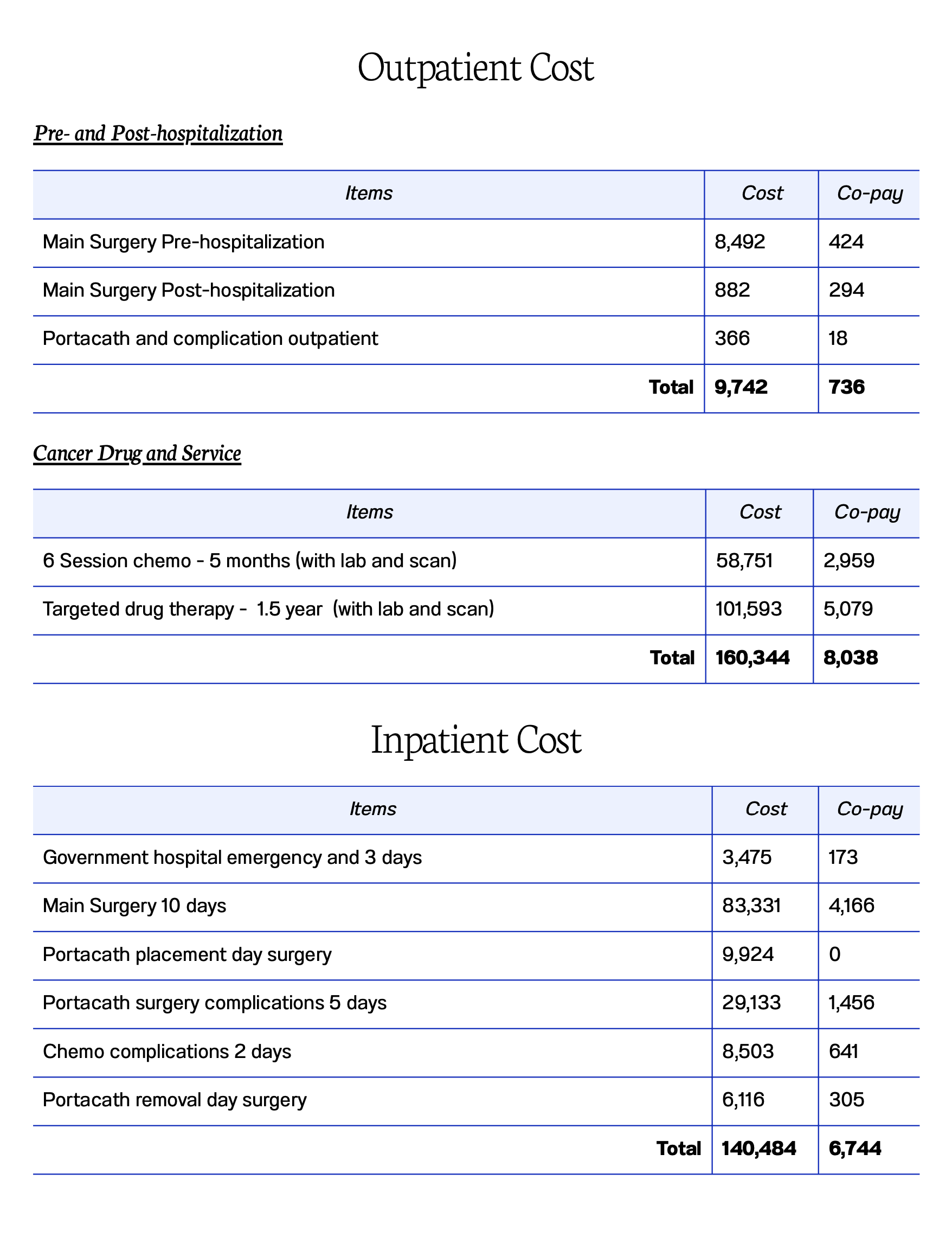
For the first surgery, portacath insertion for chemotherapy, a complication-related hospitalization, and various consultations, the total cost was approximately $130,000. The out-of-pocket expense was around $6,000.
🏥 Chemotherapy and Targeted Therapy Costs
After surgery, my mother was formally diagnosed with cancer. It was a rare sarcoma that had already metastasized, making subsequent treatment even more challenging. Our surgeon recommended a medical oncologist, and from the very first consultation, my mother felt comfortable with her.
She was attentive to patients’ emotions while remaining decisive in her treatment strategy, and she initiated high-dose chemotherapy immediately. Initially, we had planned to transfer to a public hospital after surgery for two reasons: lower treatment costs and greater experience with rare cancers.
However, we ultimately decided to continue treatment with this private oncologist because:
- Starting drug therapy immediately after surgery is critical, and transferring to a public hospital would have required joining a new queue for consultations and treatment.
- My mother was physically weak after surgery, and we wanted to minimize travel as much as possible.
After two rounds of chemotherapy, although the treatment was extremely tough, my mother persevered. Follow-up scans confirmed that the treatment was effective. She developed strong trust in her doctor, which I came to realize is invaluable in cancer treatment. Finding the right doctor involves a degree of luck, and the patient’s mindset plays a significant role in treatment outcomes.
Since our insurance covered 95% of the costs and the remaining out-of-pocket expenses were manageable, we continued treatment under this doctor.
🏥 Transition to Targeted Therapy
After five months of chemotherapy, my mother transitioned to targeted drug therapy. The dosage was adjusted multiple times until an optimal level was found. This treatment lasted for 1.5 years, during which her condition remained stable.
🏥 Cost Summary: Surgery and Post-Treatment Expenses
The table below summarizes the costs for surgery and subsequent treatment (2022 - 2024). The main difference in hospitalization co-payment depends on whether the doctor is on the insurance panel.
- Panel doctors: Under the 2023 insurance policy, there is an annual out-of-pocket cap of $3,000.
- Non-panel doctors: There is a 5% co-payment with no cap.
The Insurance Claims Process
Because we did not use a panel doctor and my mother is a foreigner, e-filing was not an option. We had to pay all costs upfront and submit claims through the insurance agent afterward.
Our insurance agent was a personal acquaintance, so initially I did not push too hard, assuming he would follow up diligently. I actively collected all required documents from the hospital and doctors and had everything ready by early February, about a month after discharge. However, an entire month passed with no updates.
At the beginning of the process, both the insurance agent and the medical concierge representative were extremely proactive, accompanying us to consultations. After I decided not to use their recommended doctor, both of them disappeared and stopped following up.
I only fully understood the conflict of interest after repeatedly chasing my insurance agent to process the claim. It became clear that there are hidden financial incentives within medical concierge services. This issue, including how such services may inflate healthcare costs in Singapore, has even been discussed in parliament, and some information is publicly available online.
After I expressed my dissatisfaction, the agent finally expedited the claims submission. By early March, I received confirmation that the claim was being processed. After submitting one additional set of original documents, the insurance payout for the major costs of the first hospitalization was credited to our PayNow account within a week.
This experience made me question my agent’s professional integrity. Nevertheless, I chose to continue trusting him and allowed him to handle subsequent claims. That trust was later shaken when I discovered serious misconduct on his part, leading to a separate insurance dispute and regulatory complaint, but that is another story.
Read More
Are Generous Health Insurance Policies Inflating Medical Costs
Using public resources responsibly is every citizen’s duty because the cost will eventually be borne by consumers in the form of premium increases
Investment Mindset that Inspires Me
Plan your life goals first, then plan your finance towards that; Live below your means; Buy term life and health insurance, that's it, then forget about insurance